Configure the widget language and attendee communications separately. Automatic translation controls supported widget wording; Multilingual communications controls the language of emails and tickets. The language selectors let you preview the widget or edit one communication language without changing every attendee’s language.

Choose the right setting

Turn on automatic widget translation

  1. Open Design → Widget and check Editing Widget so you configure the correct widget.
  2. In Quick Settings, turn on Automatic translation and wait for the update to finish.
  3. In the top-right preview controls, open Preview Language and choose the language you want to check.
  4. Review the listing, date selection, ticket choices, and checkout wording. Use Mobile Preview to check longer labels on a smaller screen.
  5. Open the installed widget to verify the visitor experience too.
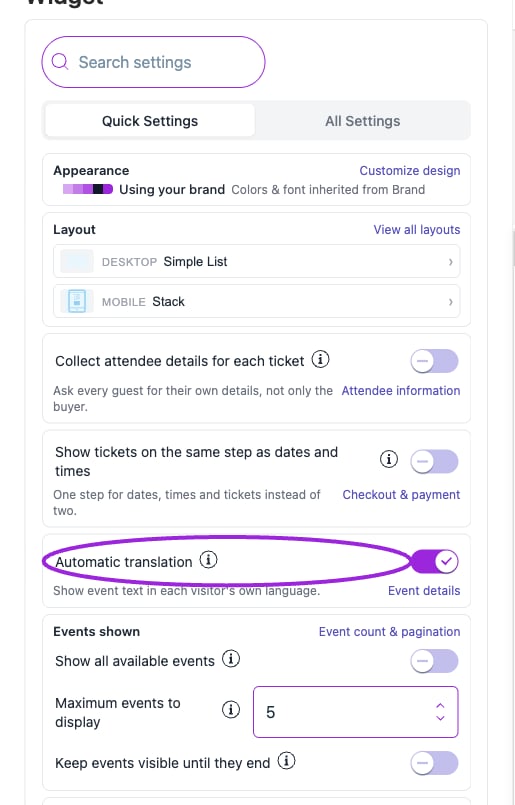
In Design → Widget → Quick Settings, Automatic translation enables supported translated labels in the widget and checkout.

In Design → Widget → Quick Settings, Automatic translation enables supported translated labels in the widget and checkout.

The same translation control is available under All Settings → Text → Event details. Automatic search filter translation covers search/filter wording; the main automatic-translation switch also enables supported filter translations. Automatic translation uses Ticket Spot’s supplied translations for supported default labels. It does not rewrite your event title, description, or custom instructions. A widget label you have changed from its default keeps your wording. If one label stays in English, check its value under All Settings → Text before assuming that the language selector is not working.

Preview language versus visitor language

Preview Language changes the editor preview. Choosing Spanish here does not force every visitor or every email into Spanish. The installed widget uses the language supplied by its integration or embed, or the visitor’s browser language when no language is supplied. Supported regional preferences use their base language for translated widget labels; an unsupported language falls back to English. Check your actual storefront or website as well as the dashboard preview.
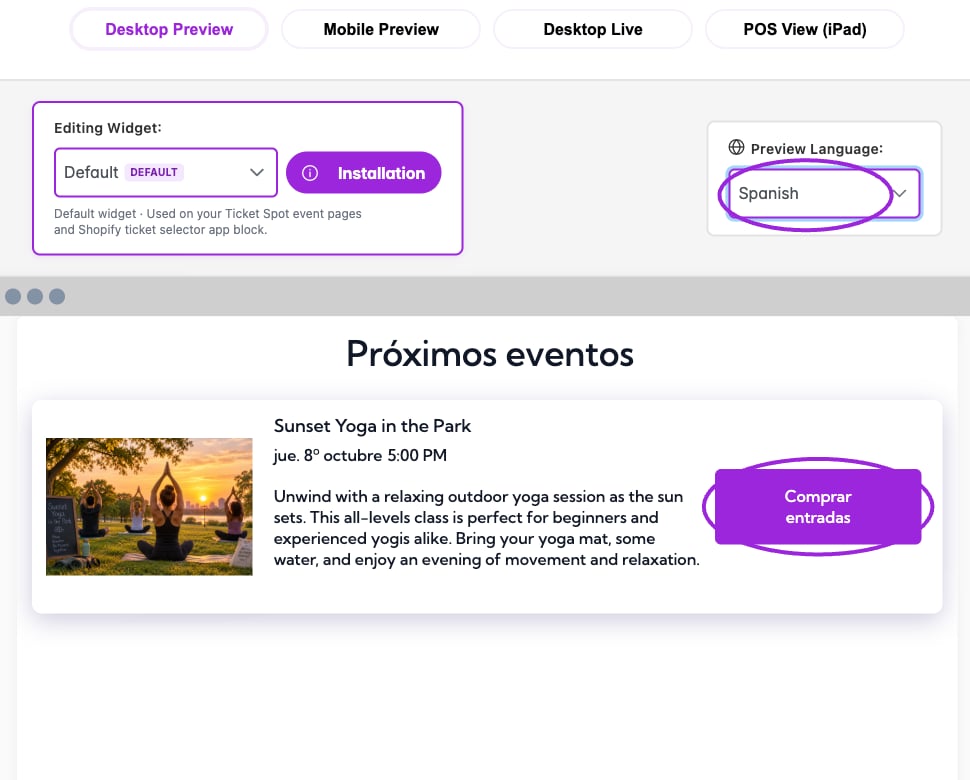
Preview Language is set to Spanish. The supplied heading, date wording, and Buy Tickets button are translated; the event’s authored title and description remain unchanged.

Preview Language is set to Spanish. The supplied heading, date wording, and Buy Tickets button are translated; the event’s authored title and description remain unchanged.

The current language choices are English, Bulgarian, Czech, Danish, Dutch, Finnish, French, German, Hungarian, Indonesian, Italian, Japanese, Korean, Norwegian, Polish, Portuguese, Spanish, and Swedish.

Enable multilingual emails and tickets

  1. Open Design → Attendee Communication.
  2. Turn on Multilingual communications. This enables attendee-language emails and tickets, with English as the fallback.
  3. Choose a template in Select Communication Type.
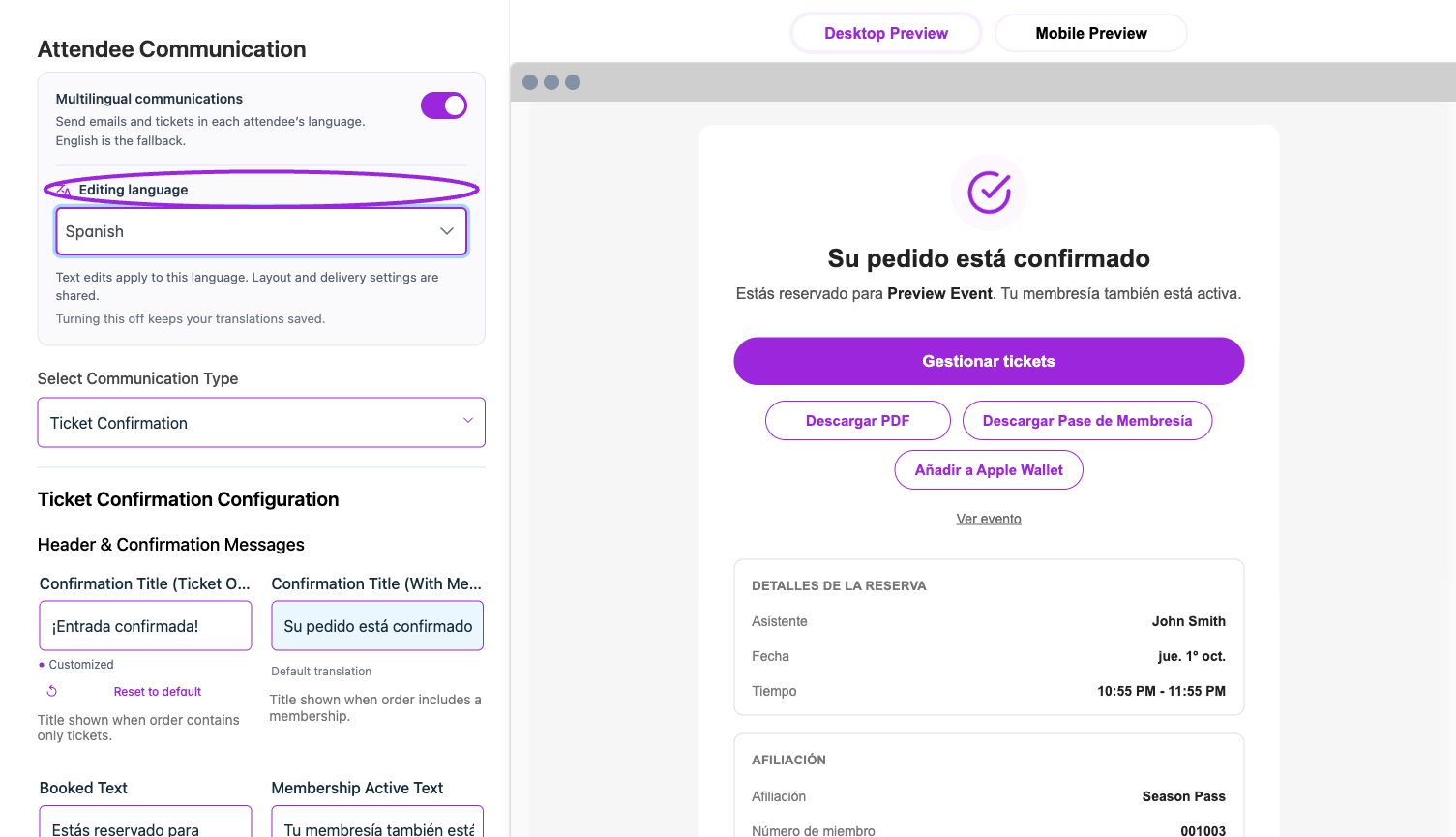
  4. Choose Editing language. Use Find a language to locate a language quickly.
  5. Review the text and its status, then change the labels or message text you want to override.
  6. Wait for saving to finish and inspect the preview in that language.
The multilingual controls also appear in Design → Tickets & Passes for supported ticket, receipt, and pass wording. The switch is shared: it is not a separate delivery setting for each template.
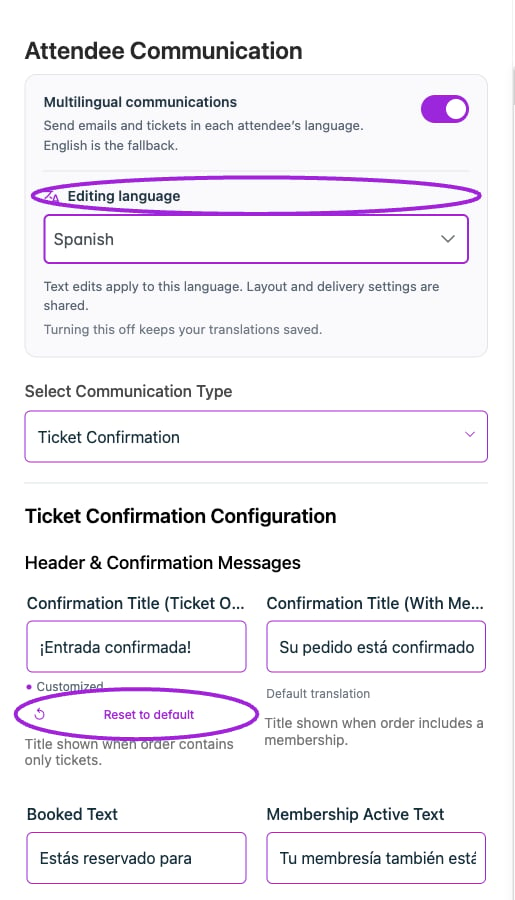
A Spanish title override is marked Customized. Reset to default restores the supplied translation for this field; other languages keep their own wording.

A Spanish title override is marked Customized. Reset to default restores the supplied translation for this field; other languages keep their own wording.

Text edits apply to Editing language. Layout, visibility, recipients, and scheduling remain shared. Turning multilingual communications off keeps your saved translations and sends the existing text to everyone.

Translate your own event email

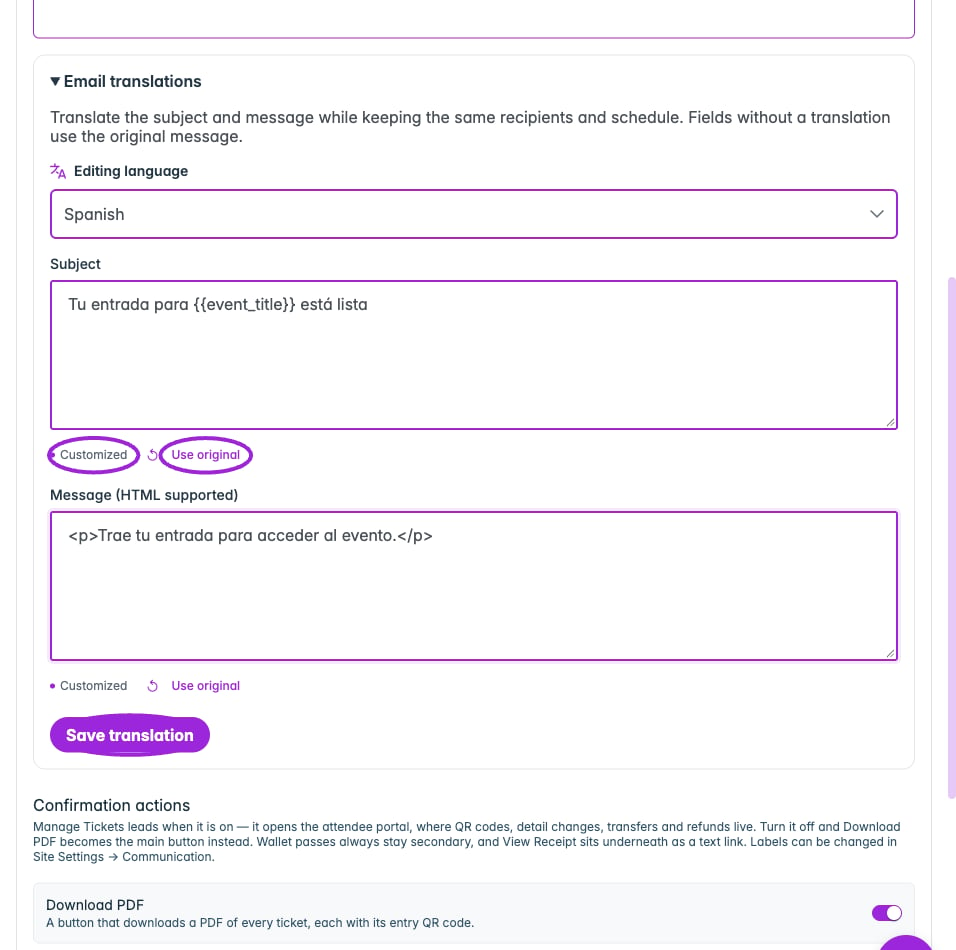
Enter a language-specific subject and message, preserving the original template variables. Customized marks the edited field; Save translation is required to persist it. This example is an unsaved draft.

Enter a language-specific subject and message, preserving the original template variables. Customized marks the edited field; Save translation is required to persist it. This example is an unsaved draft.

Custom campaign content has its own translations. Save the event email, expand Email translations, choose a language, enter its Subject and Message (HTML supported) or Email HTML, then select Save translation. Use Use original for an individual field or Reset language to remove that campaign’s saved language variant. Untranslated custom content retains the original wording. These translations use the existing recipients and schedule; they do not create another campaign. Keep personalization placeholders, such as {{event_title}}, in the translated text. Follow the multilingual email and ticket walkthrough for editing and delivery checks.

Dates, times, and other regional settings
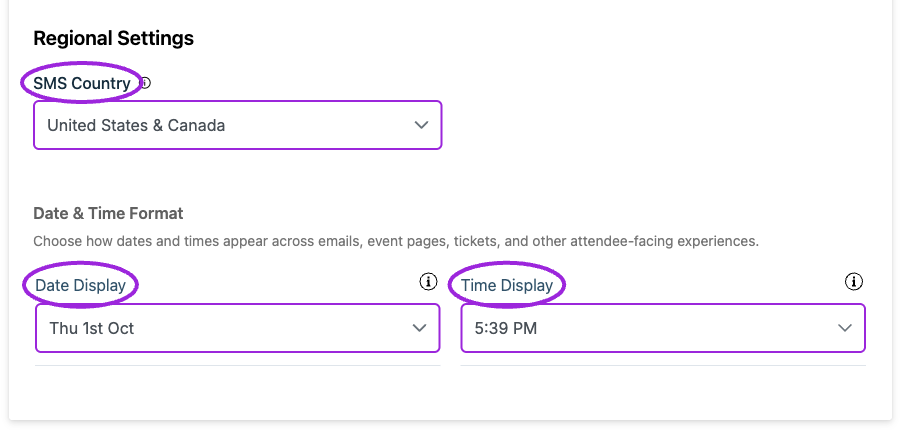
Regional Settings contains SMS Country and the shared Date Display and Time Display formats. Date and time format changes update automatically; save other General fields with Save.

Regional Settings contains SMS Country and the shared Date Display and Time Display formats. Date and time format changes update automatically; save other General fields with Save.

Open Settings → General → Regional Settings for the shared Date Display and Time Display formats used across emails, event pages, tickets, and other attendee-facing surfaces. These two controls update automatically. SMS Country selects the supported delivery region and is saved with the other General settings. See General site settings. Language and timezone are separate choices. A translated month or weekday does not move the event to another timezone. Use Date format, Time format, Show the timezone, and Convert times to the visitor’s timezone in Date & time display settings. Review the event’s own timezone and schedule too. Choosing a language does not change the ticket’s price or select a new payment currency. Configure pricing in the event’s ticket settings. For common questions and troubleshooting, see the language and locale FAQ.