
Open Analytics, choose an event or occurrence, and select Email. The report heading is Attendee Engagement. Set the range before comparing results. Screenshots use illustrative data; no messages were sent or reminders run for this documentation.

Delivery and engagement

The top cards show Delivery Rate, Open Rate, and Bounce Rate. Delivery rate is delivered divided by sent; open rate is opened divided by delivered; bounce rate is hard bounces divided by sent. Counts represent tracked attendee engagement, and the overall totals deduplicate attendees across message types rather than simply adding every type’s count.
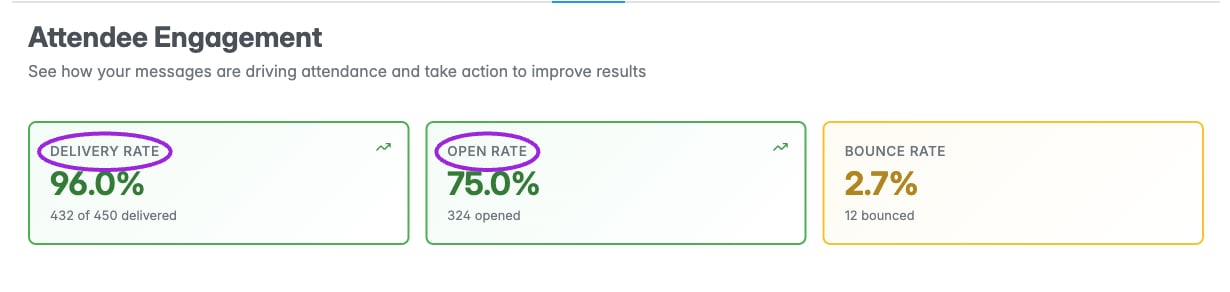
Attendee Engagement shows delivery, opens, bounces, and recommendations.

Illustrative analytics data. Attendee Engagement shows delivery, opens, bounces, and recommendations.
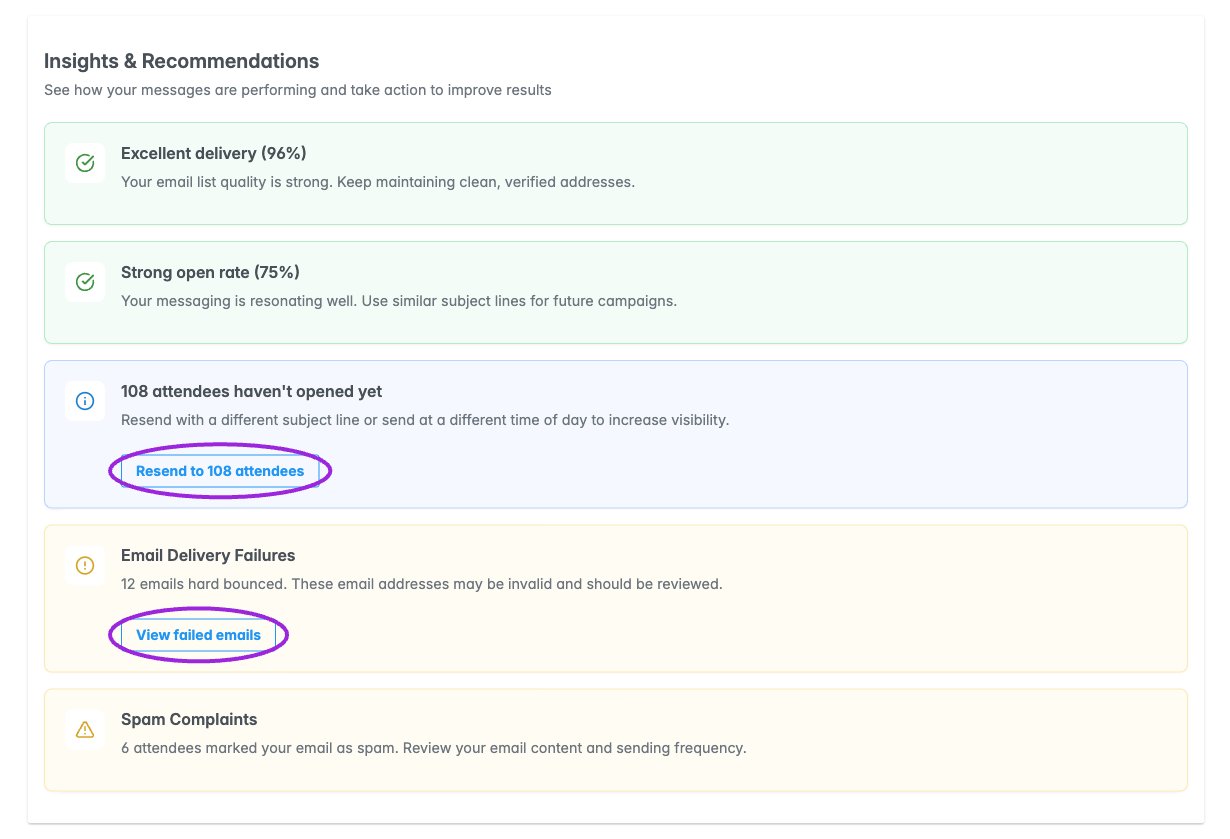
Insights & Recommendations can highlight delivery failures, unopened messages, strong or weak open rates, and spam complaints. View failed emails opens a review dialog. A Resend shortcut leads toward campaign management; it does not send directly from the insight card. Review the campaign and recipients before sending. If that shortcut does not open the expected page in your installation, use the event’s Email Communication section.
Email insights with follow-up and failed-email review controls.

Illustrative analytics data. Insights highlight unopened messages and failed delivery.
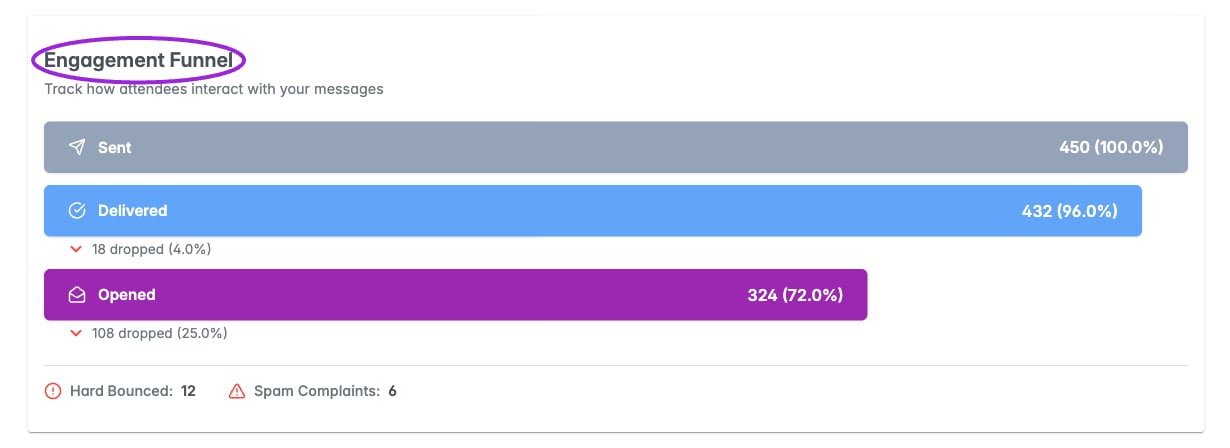
The Engagement Funnel follows Sent → Delivered → Opened and shows drop-offs. Funnel percentages are relative to sent, so its Opened percentage can differ from the Open Rate card, which uses delivered as its denominator.
The engagement funnel shows delivery and open drop-offs.

Illustrative analytics data. The engagement funnel shows delivery and open drop-offs.

Performance by Message Type

The three message-type cards are New Order, Event Reminders, and Post Event. Each can show sent/delivered/opened statistics or a scheduled-reminder state. A pending or scheduled reminder takes precedence over earlier statistics for that type.
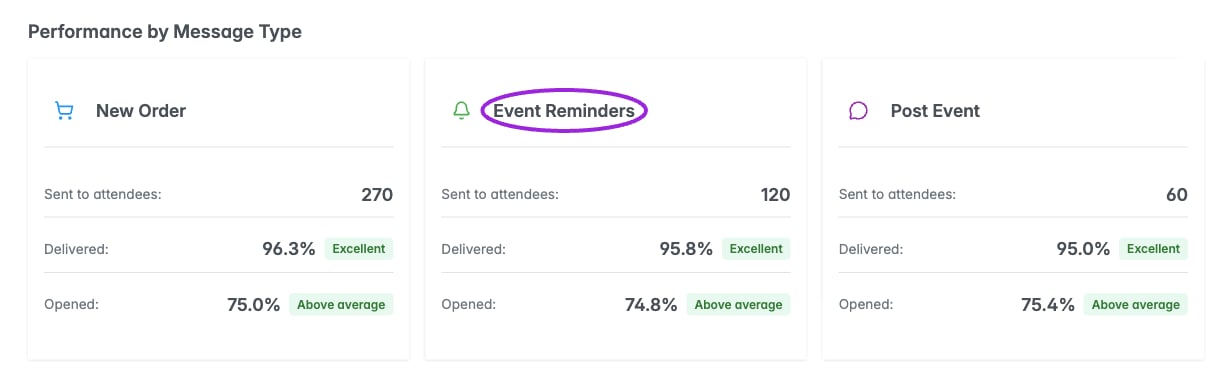
Compare new-order, event-reminder, and post-event message performance.

Illustrative analytics data. Compare new-order, event-reminder, and post-event message performance.
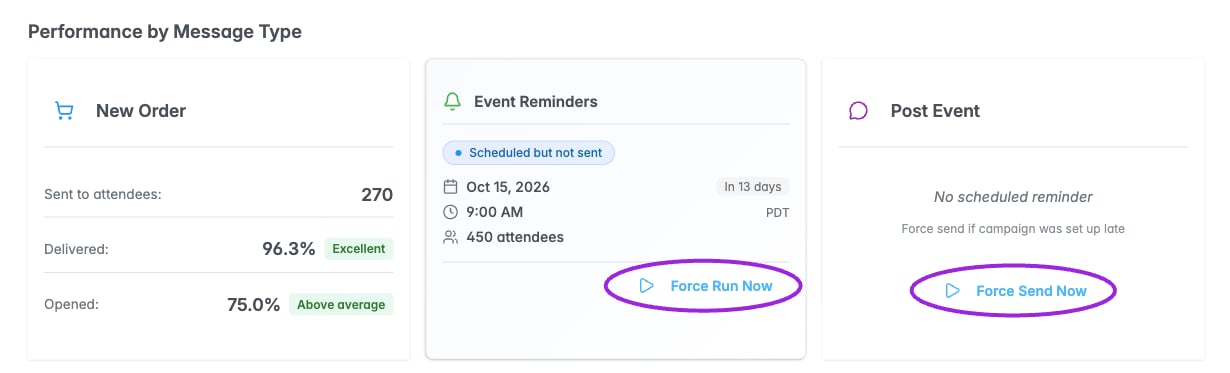
A scheduled card shows its date, time, timezone, estimated attendee count, and state, including overdue or completed/sent information when applicable.
Scheduled reminders show their timing, timezone, and attendee count.

Illustrative analytics data. Scheduled reminders show their timing, timezone, and attendee count.
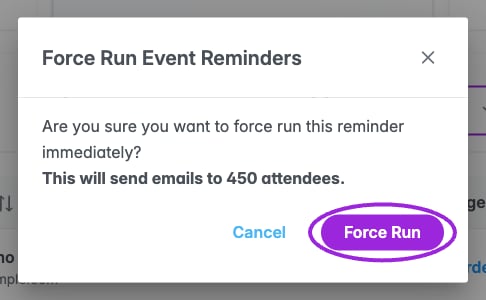
Force Run Now opens a confirmation for an existing scheduled reminder. Confirming runs that reminder immediately. Force Send Now, shown where there is no scheduled reminder/activity for the reminder or post-event type, opens a separate confirmation that creates a reminder and sends the campaign to eligible attendees. These actions send real email when confirmed; they are not preview controls.
Review the Force Run confirmation before running a scheduled reminder.

Illustrative analytics data. Review the Force Run confirmation before running a scheduled reminder.
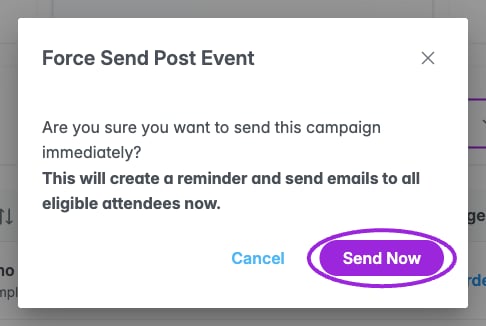
Force Send confirms immediate delivery to eligible attendees.

Illustrative analytics data. Force Send confirms immediate delivery to eligible attendees.

Detailed Activity Log

Search by attendee name, email, subject, or event title. Filter All Trigger Types to New Order, Event Reminder, or Post Event, and filter All Statuses to Sent, Delivered, Opened, Hard Bounce, or Spam Complaint. The filters narrow the returned activity records; they do not recalculate the summary cards. Columns show Event, Recipient, Subject, Message Type, and Engagement Status, including the latest status timestamp. Sort the columns and use the twenty-row pagination. The visible status menu does not contain a separate Clicked option.
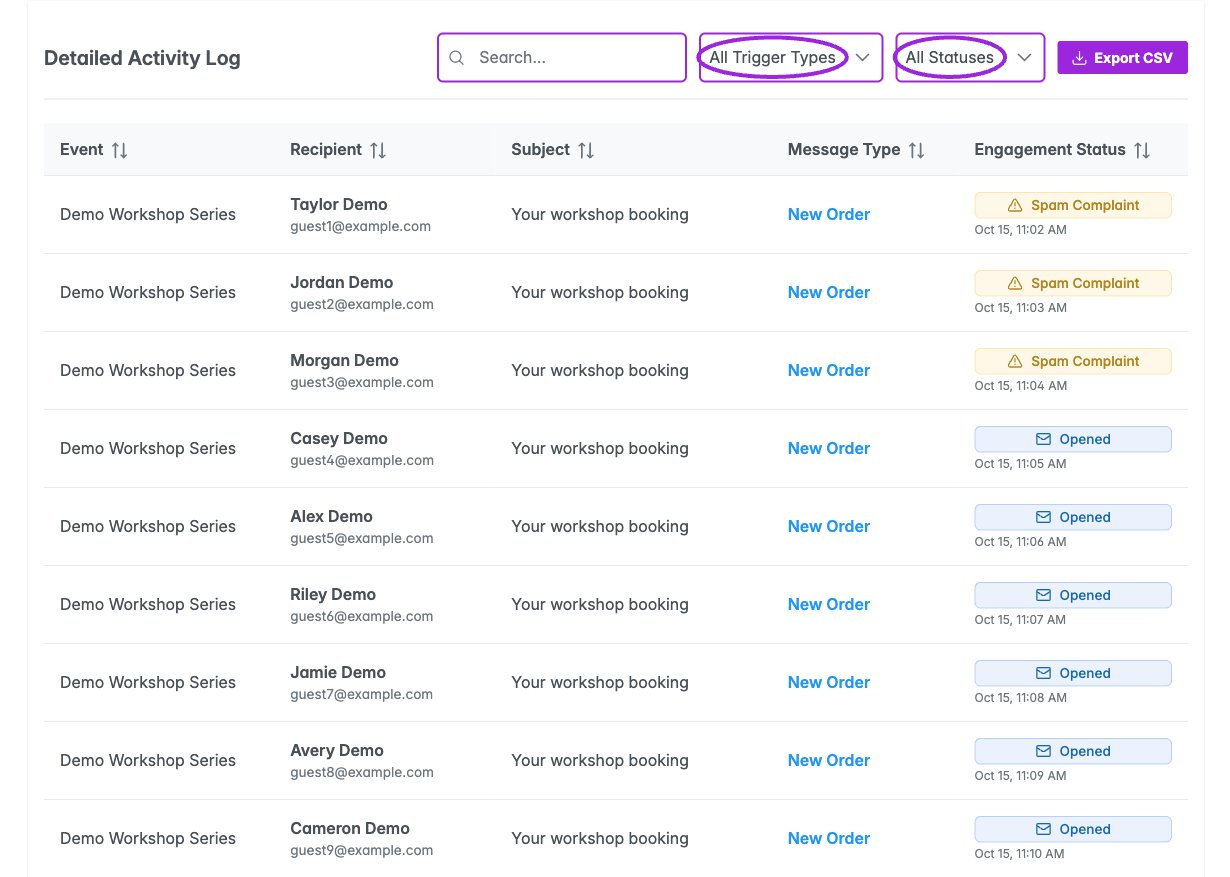
Search, filter, sort, and export the detailed email activity log.

Illustrative analytics data. Search, filter, sort, and export the detailed email activity log.

Review failed emails

Choose View failed emails or the failed-delivery insight action. Fix Failed Emails lists hard bounces and spam complaints with the latest recorded date/time. Use Copy All or the per-row copy control to copy addresses. Edit opens the attendee record where you can correct an address when appropriate; it does not resend the failed email.
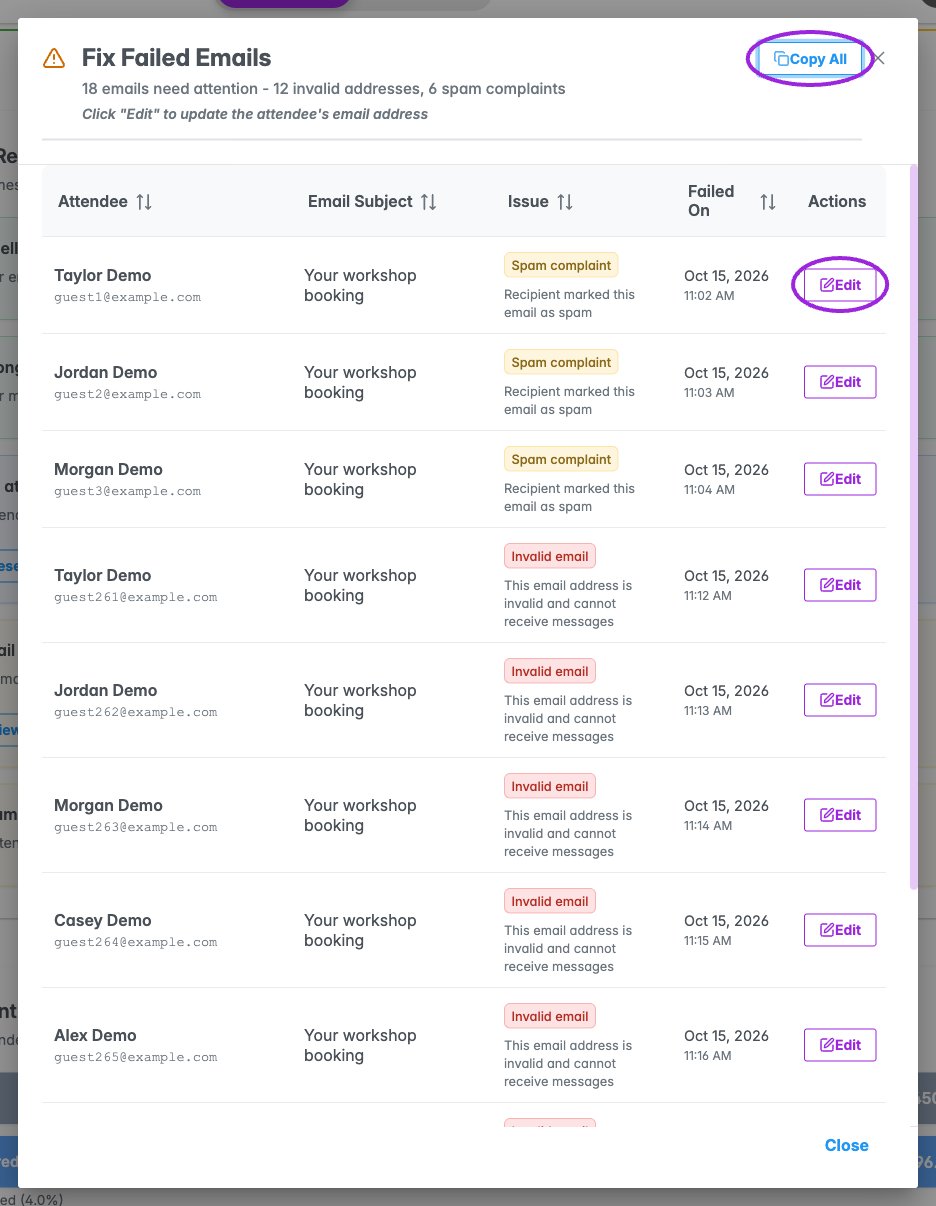
Review failed addresses and spam complaints before changing attendee records or messaging again.

Illustrative analytics data. Review failed addresses and spam complaints before changing attendee records or messaging again.

Export and empty states

The activity table’s Export CSV sends the selected message type and the report’s range. It does not apply the table’s search or status filter. The top Export CSV exports the event/range without the table’s message-type selection. Neither export is limited to the visible twenty-row page. The CSV includes event, recipient, subject, campaign/message type, latest status and time, plus available sent, delivered, opened, clicked, bounced, and spam-complaint timestamps. A report without activity can return an empty result. If messages are scheduled but not sent, scheduled cards can still appear while engagement is empty. For delivery setup and translated subject/content defaults, see Email Communication and Multilingual communications.